
Why Can Two “1 Gig” Internet Quotes Be So Different?
Dedicated vs. Shared Internet: What Determines Your Business Internet Cost?
Why Can Two “1 Gig” Internet Quotes Be So Different?
June 24, 2025
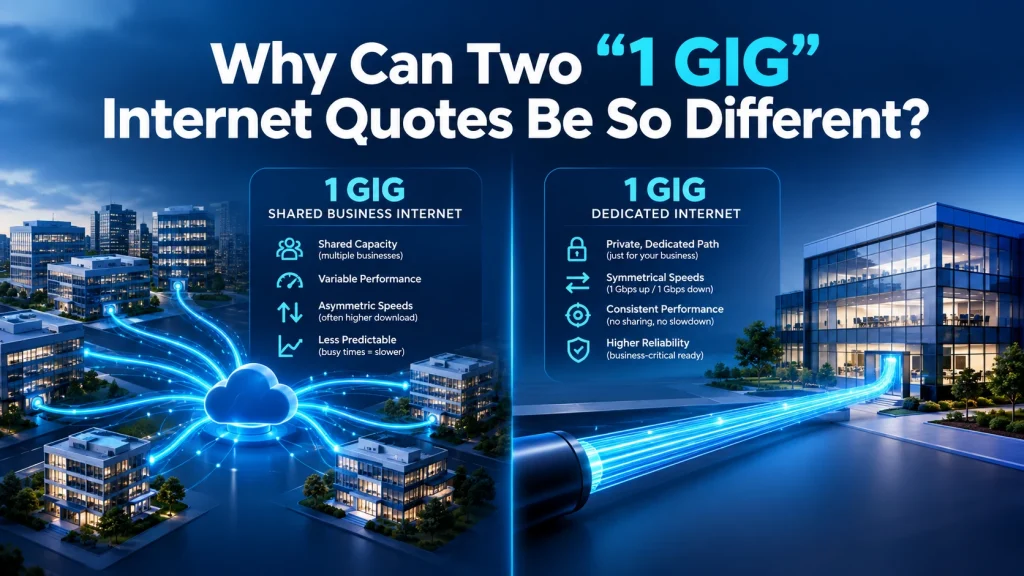
Choosing the right business Internet connection can have a direct impact on productivity, cloud applications, communications, and day-to-day operations.
One of the most important decisions is whether your business needs shared Internet or Dedicated Internet Access (DIA).
Both options can provide high-speed connectivity. However, they differ significantly in how bandwidth is delivered, how network performance is managed, and what service commitments are available.
For businesses that depend heavily on reliable Internet connectivity, understanding these differences can help determine which service better matches their operational requirements.
What Is Shared Business Internet?
Shared Internet is a connection where network capacity is shared among multiple customers using the provider’s infrastructure.
Business broadband services can provide high download speeds at a relatively accessible cost. However, actual network performance can vary depending on network traffic, service design, location, and other factors.
Shared Internet can be suitable for businesses that primarily use:
- Web browsing
- Cloud applications
- Online collaboration
- Standard video conferencing
- General business applications
For many small businesses, shared broadband can provide the connectivity they need without the cost of a dedicated connection.
However, businesses with more demanding network requirements may need to consider Dedicated Internet Access.
What Is Dedicated Internet Access?
Dedicated Internet Access (DIA) provides a dedicated connection and bandwidth for the business.
Instead of sharing the service’s committed bandwidth with other customers, the business receives an exclusive connection designed around its requirements.
iTeraTEL describes its DIA service as providing a leased line with exclusive bandwidth, synchronous and guaranteed bandwidth, and service-level commitments.
DIA is generally designed for organizations that require more predictable network performance and stronger service commitments.
Dedicated vs. Shared Internet: The Key Differences
The most important differences include:
| Feature | Shared Business Internet | Dedicated Internet Access |
|---|---|---|
| Bandwidth | Shared network capacity | Dedicated bandwidth |
| Performance | Can vary with network conditions | More predictable |
| Upload / Download | Often asymmetrical | Typically symmetrical |
| SLA | Depends on service | Defined performance commitments |
| Scalability | Suitable for many SMB needs | Designed for higher-demand requirements |
| Cost | Generally lower | Generally higher |
| Best for | General business use | Business-critical connectivity |
The exact features vary by provider and service, so businesses should always review the specific service agreement before making a decision.
Dedicated Bandwidth vs. Shared Bandwidth
Bandwidth is one of the biggest differences between the two service models.
With shared Internet, the provider’s network capacity is shared across customers.
With DIA, the business receives dedicated bandwidth.
This distinction becomes increasingly important when an organization has multiple employees, locations, cloud applications, VoIP systems, video conferencing, or large amounts of data moving across the network.
A connection that appears fast during normal usage may still experience performance challenges when demand increases.
Dedicated bandwidth provides a more predictable foundation for businesses with higher or more consistent network requirements.
Download Speed Is Not the Whole Story
Internet plans are often compared based on download speed.
However, businesses should also consider:
- Upload speed
- Latency
- Packet loss
- Jitter
- Network availability
- Bandwidth consistency
- Service-level commitments
- Technical support
For example, a business may have a high download speed but still experience problems with applications that require substantial upload capacity.
This can affect cloud backups, file transfers, video conferencing, remote access, and other business applications.
Symmetrical Internet for Business
Many shared Internet services provide faster download speeds than upload speeds.
Dedicated Internet Access can provide symmetrical bandwidth, meaning the upload and download speeds are the same.
This can be particularly useful for organizations that regularly send large amounts of data to cloud services or remote locations.
Examples include:
- Cloud backups
- Video conferencing
- Large file transfers
- Cloud-based applications
- Remote desktop services
- Hosted communications
- Data synchronization
- Multi-location connectivity
iTeraTEL’s DIA service is designed around synchronous, guaranteed bandwidth.
Internet Performance During Peak Usage
Shared networks can experience changes in performance depending on network conditions and traffic.
For a business, this can become noticeable when many employees are simultaneously using cloud applications, video meetings, file transfers, voice services, and other bandwidth-intensive applications.
Dedicated Internet is designed to provide more predictable performance because the committed bandwidth is dedicated to the customer.
This can be particularly important for businesses that cannot easily tolerate network performance fluctuations.
Service Level Agreements: Shared vs. Dedicated Internet
Another important difference is the Service Level Agreement (SLA).
An SLA defines specific service commitments made by the provider.
Depending on the service, these commitments may address:
- Network availability
- Latency
- Packet loss
- Jitter
- Response times
- Restoration procedures
- Service credits
iTeraTEL’s Dedicated Internet Access includes SLA commitments covering performance characteristics such as latency, packet loss, jitter, and mean opinion score (MOS), along with dedicated customer support.
Businesses should always review the actual SLA rather than relying only on advertised uptime or speed.
Which Businesses Need Dedicated Internet?
Dedicated Internet may be appropriate for organizations that depend heavily on consistent network performance.
Examples include:
Multi-Location Businesses
Organizations connecting multiple offices may require predictable connectivity between locations and cloud resources.
Cloud-Dependent Businesses
Companies that rely heavily on cloud applications can benefit from consistent network performance.
Contact Centres
Contact centres depend on reliable Internet connectivity for voice, customer-service applications, call routing, reporting, and other systems.
Financial and Professional Services
Businesses that regularly transfer sensitive or large amounts of data may require more predictable connectivity.
E-Commerce Businesses
Online businesses depend on reliable connectivity for operations, payment processing, customer service, and access to cloud platforms.
Businesses With Large Data Requirements
Organizations that regularly transfer large files or synchronize data between locations may benefit from symmetrical dedicated bandwidth.
Which Businesses Can Use Shared Internet?
Shared business Internet can be appropriate for organizations with more conventional connectivity requirements.
It may be suitable for businesses that primarily use:
- Web applications
- Microsoft 365
- Cloud software
- VoIP
- Video conferencing
- Online collaboration
- General Internet access
A small business with moderate Internet usage may not require the additional performance commitments associated with DIA.
The important consideration is how the business actually uses its Internet connection.
Dedicated Internet vs. Shared Internet Cost
One of the biggest considerations is cost.
Shared business Internet is generally less expensive because network infrastructure and capacity are shared among customers.
Dedicated Internet typically costs more because the business receives dedicated bandwidth and stronger service commitments.
However, businesses should consider the total operational cost of connectivity, rather than looking only at the monthly Internet bill.
If an unreliable or inconsistent connection causes:
- Employee downtime
- Failed transactions
- Communication problems
- Cloud application interruptions
- Customer-service delays
- Lost productivity
the operational cost can exceed the difference between Internet plans.
The right choice therefore depends on the business’s connectivity requirements and the consequences of network performance problems.
Dedicated Internet for Business Continuity
Internet connectivity can be critical to business continuity.
A company may rely on its Internet connection for:
- Business phone systems
- Payment processing
- Cloud applications
- Remote workers
- Customer service
- Security systems
- Data backups
- Online sales
For this reason, businesses with critical connectivity requirements should consider both primary Internet performance and backup connectivity.
A common strategy is:
Dedicated Internet + 5G/LTE Backup
Another option may be:
Fibre + Fixed Wireless
The best configuration depends on location, availability, network architecture, and business requirements.
iTeraTEL also offers managed SD-WAN solutions that can intelligently route applications across multiple connections and support failover configurations.
Dedicated Internet and Network Security
Dedicated Internet can also be incorporated into a broader network security strategy.
Businesses can combine dedicated connectivity with:
- Firewalls
- Managed security
- SD-WAN
- Network monitoring
- Managed IT
- Secure remote access
DIA itself should not be treated as a complete cybersecurity solution.
Security depends on the overall network architecture, including firewalls, endpoint protection, access controls, monitoring, and other security measures.
How Much Dedicated Bandwidth Does a Business Need?
There is no single bandwidth requirement that fits every organization.
The appropriate capacity depends on factors such as:
- Number of employees
- Number of locations
- Cloud applications
- Voice traffic
- Video usage
- File transfers
- Backup requirements
- Remote workers
- Business applications
- Future growth
iTeraTEL’s published DIA offering supports bandwidth options typically ranging from 100 Mbps to 10 Gbps or more, depending on requirements and availability.
Businesses should evaluate current usage and expected growth rather than simply purchasing the highest available speed.
Questions to Ask Before Choosing Business Internet
Before selecting shared or dedicated Internet, ask:
- How many employees use the connection?
- How dependent is the business on cloud applications?
- How much upload bandwidth is required?
- Does the business use VoIP or video conferencing?
- Does the business have multiple locations?
- Are there critical applications that cannot tolerate downtime?
- Does the service include an SLA?
- What network performance does the SLA cover?
- Is backup Internet required?
- How much bandwidth will the business need as it grows?
These questions can help determine whether shared Internet or DIA is appropriate.
Dedicated vs. Shared Business Internet: A Simple Guide
Choose Shared Business Internet when:
- Internet requirements are moderate.
- Cost is a major consideration.
- Applications are not highly bandwidth-intensive.
- Some variation in network performance can be tolerated.
- The business does not require dedicated bandwidth.
Consider Dedicated Internet Access when:
- Connectivity is business-critical.
- Predictable performance is important.
- The business needs dedicated bandwidth.
- Symmetrical upload and download speeds are valuable.
- The organization relies heavily on cloud applications.
- Multiple locations need reliable connectivity.
- The business requires defined SLA commitments.
- Downtime or network performance issues can have significant operational consequences.
Neither option is universally appropriate. The right choice depends on the organization’s applications, network requirements, budget, and business continuity needs.
Why Businesses Choose iTeraTEL for Dedicated Internet
iTeraTEL provides Dedicated Internet Access for Canadian businesses that require dedicated bandwidth and predictable network performance.
Its DIA service includes:
- Dedicated bandwidth
- Synchronous connectivity
- SLA-backed performance
- Latency commitments
- Packet-loss commitments
- Jitter commitments
- Carrier-neutral connectivity
- Multiple carrier options
- 24/7 dedicated customer support
- Scalable bandwidth options
iTeraTEL also states that its carrier-neutral approach allows it to use connectivity from multiple last-mile providers, providing additional flexibility when designing business connectivity.
The Right Business Internet Depends on Your Requirements
The choice between shared and dedicated Internet should not be based on speed alone.
Businesses should consider performance, bandwidth, upload requirements, reliability, SLA commitments, scalability, redundancy, and the operational impact of downtime.
For businesses with moderate connectivity needs, shared Internet may provide the appropriate balance of service and cost.
For organizations that depend heavily on Internet connectivity and require predictable performance, Dedicated Internet Access can provide a stronger foundation for business-critical operations.
The best approach is to evaluate how your business uses its network today and how those requirements are likely to change as the organization grows.
Need Help Choosing Business Internet?
iTeraTEL helps Canadian businesses evaluate Internet connectivity based on their bandwidth, performance, reliability, scalability, and business continuity requirements.
Whether you need business broadband, fibre, Dedicated Internet Access, fixed wireless, or backup connectivity, iTeraTEL can help identify an Internet solution aligned with your organization’s needs.